There is no single best chef coat, only the right coat for a given station and a given kitchen. An executive chef greeting guests in an open kitchen, a line cook working a wood-fired grill, and a pastry chef in a cooler prep area have genuinely different needs, and a uniform program that ignores those differences ends up with coats that are too hot, wear out too fast, or look wrong for the room. This guide matches the jacket to the job so you can specify the right features for each role instead of buying one compromise coat for everyone.
Read the heat and the flame before anything else
The first question is not color or logo placement, it is how much direct heat and open flame the wearer faces, because that decides sleeve length and fabric. Long sleeves are the burn-protection choice, shielding the forearms from splatter, oven edges and flare-ups, which is why classical fine-dining lines and any station with frequent open flame favor them. Short sleeves, or a coat designed to roll cleanly, win on airflow at wood-fired grills, wok stations and other high-heat spots where a long sleeve becomes a sweat trap. Fabric follows the same logic: near sustained open flame, remember that polyester is a thermoplastic fiber that can soften and melt against skin, while cotton chars instead, so flame-heavy stations lean toward higher cotton content even though blends win elsewhere.
The executive chef and the open kitchen
When the coat is seen by guests, presentation leads. Executive chefs and anyone working an open kitchen or chef’s table are effectively in the dining room, so a crisp long-sleeve coat that resists wrinkling through a full service matters as much as protection. This is the classic case for a durable poly-cotton blend in white, which reads as clean and professional and holds a pressed look, often with the double-breasted front that lets the wearer reverse the panel to hide a stain mid-service. It is also where custom branding earns its keep, since an embroidered restaurant logo on a sharp white coat is quietly doing marketing work every time a guest looks toward the pass.
The hot line and grill stations
On the line, comfort and stain tolerance beat formality. Cooks working sustained heat need airflow and a fabric that survives constant washing, so this is where short sleeves, breathable cotton or a moisture-wicking performance fabric, and darker colors come together. Black and charcoal coats have surged in popularity precisely because they hide the inevitable grease and sauce, look modern, and photograph well for a restaurant’s social feed. Venting details, such as mesh underarm panels or a vented back yoke, and a fabric that dries quickly between shifts do more for a line cook’s comfort than any styling flourish. Buttons matter here too: cloth knot buttons and sturdy snaps survive commercial laundering better than cheap plastic, and a coat that loses buttons every wash cycle becomes a constant repair chore. Many kitchens also use color to mark hierarchy, keeping the head chef in white while line cooks wear black or grey, which doubles as an at-a-glance org chart during a rush.
Pastry, prep, and cooler stations
Away from the flame, the priorities shift to all-day comfort. Pastry and prep cooks spend long stretches in cooler areas without the open-flame exposure of the hot line, so breathability and freedom of movement outrank maximum burn protection. Lighter cotton or comfortable blends work well here, and short sleeves are fine where there is little flame risk. A slightly relaxed fit that allows reaching, piping and plating without binding across the shoulders is often more valuable than a tailored silhouette. Because these stations are usually out of the guest’s sightline, stain-hiding color and crisp presentation matter less than a coat that stays comfortable through a long, detail-heavy shift, though many kitchens still keep the whole team in a coordinated look for the moments when a pastry chef does step out to finish a dessert tableside.
Let the fabric and color follow the role
Once the roles are mapped, fabric choice becomes straightforward. 100% cotton breathes best and feels the most traditional, but it wrinkles and can shrink, so it suits flame-heavy or comfort-first stations that can tolerate a rumpled look. Poly-cotton blends, typically 65/35 or 55/45, are the durable, wrinkle-resistant, quick-drying workhorses that survive heavy laundering, which is why they dominate uniform programs. Performance fabrics add moisture-wicking for the sweatiest high-output stations. The two charts below show how these fabrics trade off and what they are actually made of, so you can see why higher polyester content buys durability and drying speed at the cost of some breathability.
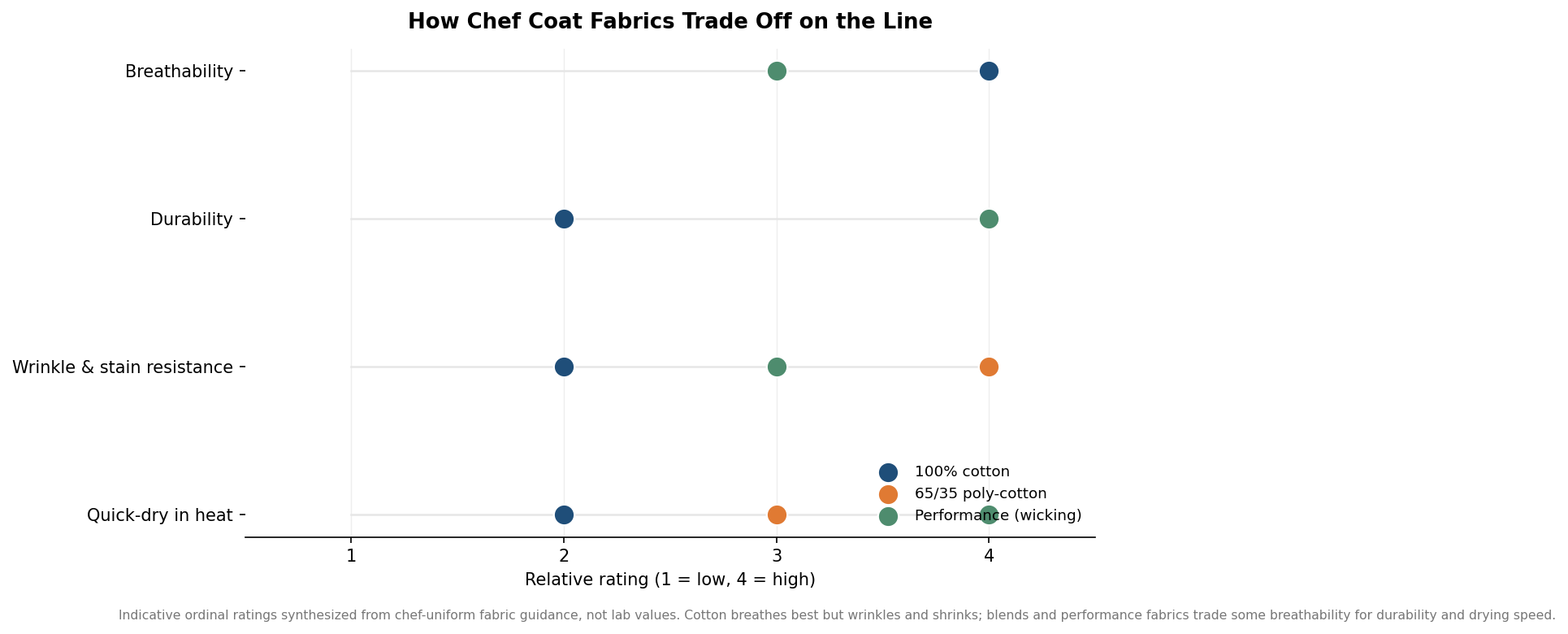
Composition is the other half of the story, because the blend ratio is what drives most of those differences. A coat’s fiber content is not a marketing detail; it predicts how the garment will launder, wrinkle and hold up over hundreds of wash cycles in a commercial laundry.
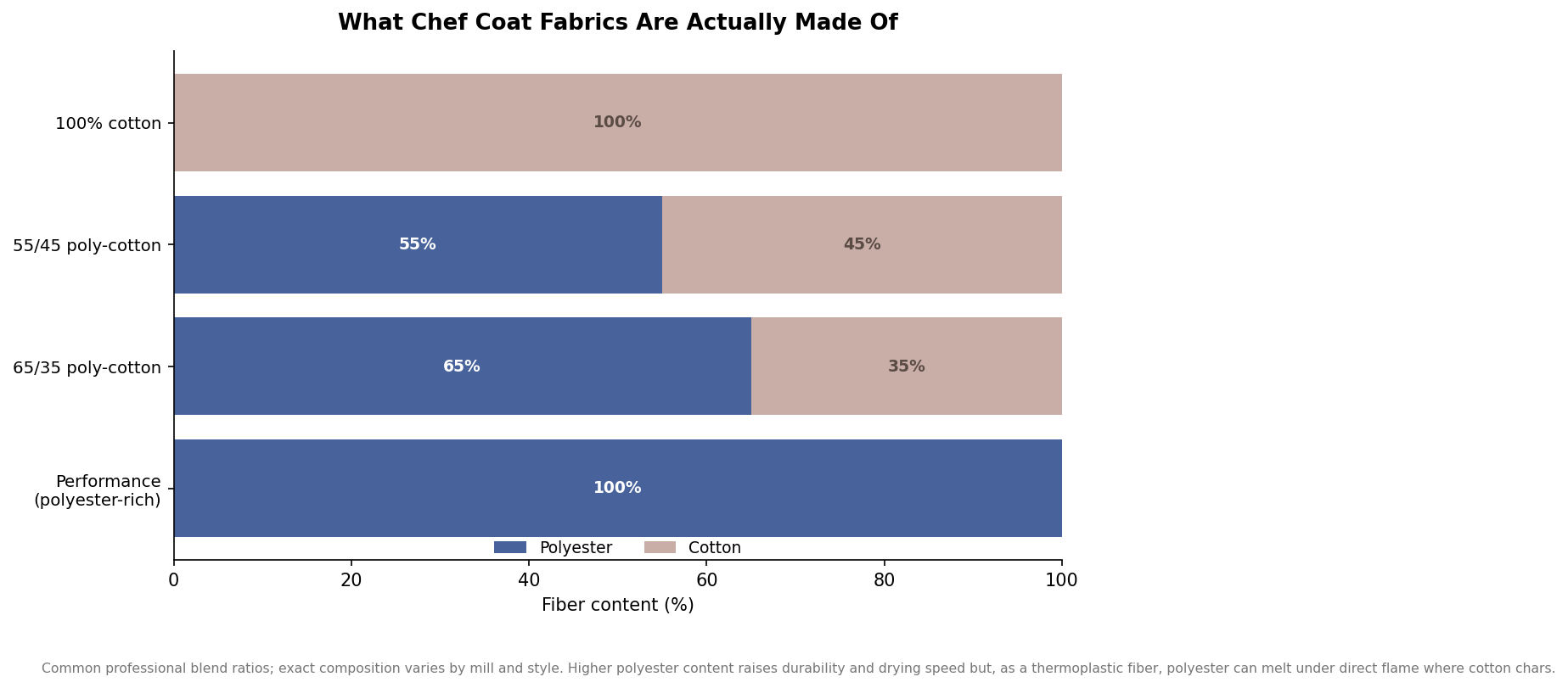
The practical way to run this is as a small matrix rather than a single order. Decide which roles need long versus short sleeves, which need white for presentation versus black for stain tolerance, and which fabric weight and blend fit each station’s heat and laundry load, then order to that plan. Ask any supplier for sample coats in the specific fabrics before committing, wash them the way your laundry will, and confirm sizing across the range of body types on your team. A uniform program built role by role costs a little more thought up front and saves you from a stockroom full of coats that nobody wants to wear on their station.